Paperwhites: forcing bulbs indoors for winter flowers
Paperwhite narcissus bloom indoors without a cold period. Extension guidance on containers, water level, temperature, staking and what to do with the bulbs afterward.
Most spring bulbs need weeks in the cold before they will flower indoors. Paperwhites skip that step entirely, which is why they show up in bowls and on kitchen counters from Thanksgiving onward. The trade-off is that they are a one-season plant: you plant them, enjoy them, and compost them.
Why paperwhites need no chilling
Clemson Cooperative Extension lists paperwhite narcissus, the yellow cultivar 'Soleil d'Or' and the Chinese sacred lily as bulbs that can be forced without cooling.2 Iowa State University Extension makes the same point: paperwhites need no cold storage period.1 If you want hyacinths or tulips for the same windowsill, they follow a different schedule, so see our guide to forcing hyacinth bulbs in a glass.
Planting in pebbles and water
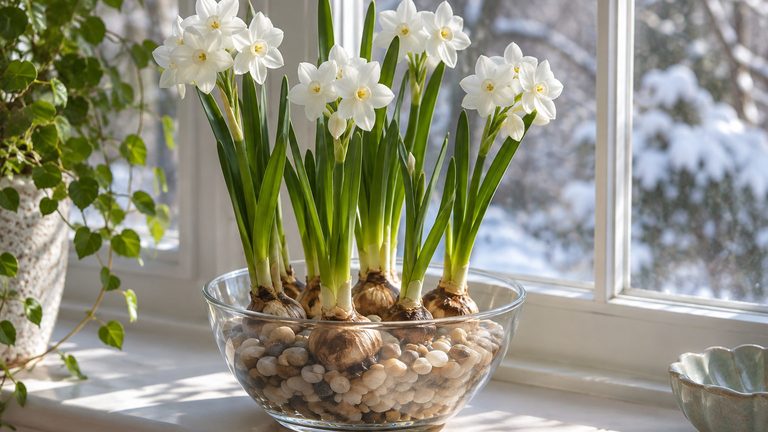
Both extension services describe the same simple setup. Choose a clear, shallow bowl without drainage holes,1 or a decorative dish at least 2 to 3 inches deep.2 Fill it with pebbles, pea gravel, coarse sand or pearl chips, set the bulbs on top, and add more stones around them.12
The details differ slightly, so pick one approach and stay consistent:
- Iowa State says to add water until it touches the bottom of the bulbs and to keep it at that level through forcing.1
- Clemson says to cover the bottom quarter of each bulb with gravel and keep the water just below the surface of the gravel.2
Either way, Clemson warns that too much water rots the bulbs, so keep the level steady rather than flooding the bowl.2 You can also plant into a pot of potting soil, setting the bulbs on the surface and adding soil so the tips stay exposed.1
The cool, dark start
After planting, the bulbs want to root before they grow tall. Iowa State recommends a cool (45 to 50°F) dark place for 2 to 3 weeks to encourage root growth.1 Clemson suggests a slightly warmer 50 to 60°F in low light until the bulbs are well rooted and shoots appear, usually in two to three weeks.2 A cool basement, an unheated spare room or an enclosed porch that stays above freezing all fit.
Moving them into the light
Once shoots reach about 3 inches, Iowa State says to move the plants to a sunny window at 60 to 70°F.1 Clemson advises moving them gradually into direct sunlight and warmer temperatures.2 You can extend the show by moving the plants out of direct sun once they begin to flower.1
From bulb to bloom, stage by stage
| Stage | What to do | Source |
|---|---|---|
| Container | Clear bowl, at least 2 to 3 inches deep, no drainage holes | Iowa State, Clemson |
| Water | At the base of the bulbs, not over them | Iowa State, Clemson |
| Rooting | Cool and dim, 2 to 3 weeks | Iowa State, Clemson |
| Bright window | When shoots reach about 3 inches, 60 to 70°F | Iowa State |
| Bloom care | Move out of direct sun to prolong flowers | Iowa State |
Keeping tall stems upright
Paperwhites can become top-heavy. Iowa State notes that plants may reach 18 to 20 inches tall and often need staking.1 Clemson suggests supporting them with a decorative ribbon.2
Spreading out the flowers
If you want blooms for weeks rather than days, plant in batches. Clemson recommends successive plantings about two weeks apart starting after mid-October, which can give indoor flowers from Thanksgiving until late March.2 One variety behaves differently: Iowa State says 'Grand Soleil d'Or' takes 1 to 2 weeks longer to force than other varieties, so plant it earlier.1
After the flowers fade
Both extension services give the same answer: discard the bulbs. They cannot be forced again, and Iowa State adds that they are not winter-hardy outdoors.12 If your tastes run to bulbs that return, the amaryllis guide covers another bulb for winter flowers, and the Christmas cactus article covers a plant that blooms for the holidays.