
How to soften hard brown sugar, with bread or a microwave
Brown sugar turns hard when its moisture escapes. Two extension-recommended ways to soften it, one slow with a slice of bread and one fast in the microwave, plus how to keep it soft.
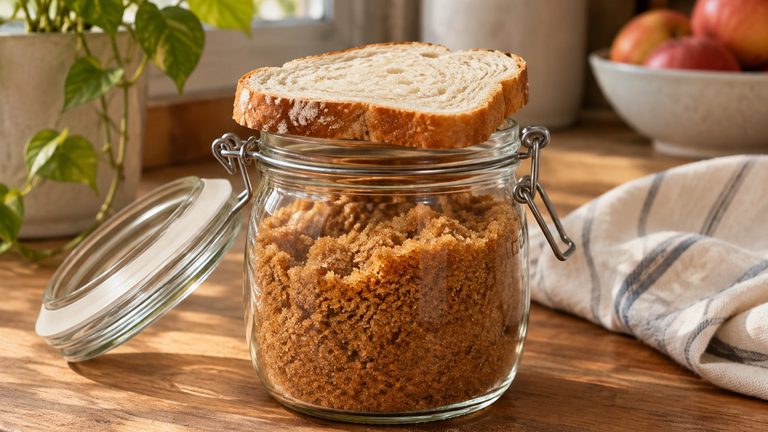
A brick of brown sugar in the pantry is a common baking-day surprise, and it does not mean the sugar is ruined. Nothing is wrong with it except the missing water, and both methods below work by putting water back into the crystals.
Why brown sugar turns into a brick
Brown sugar is white sugar with molasses added back in. University of Illinois Extension notes that light brown sugar contains about 3.5% molasses by weight and dark brown sugar about 6.5%.3 Molasses attracts water, which is what keeps brown sugar soft and moist in the bag.3
Once the sugar is exposed to air, that moisture evaporates and the sugar can become "as hard as a brick."3 Kansas State University Extension explains the mechanism: the remaining moisture acts like a glue that binds the sugar crystals into hard lumps, and most containers are not fully airtight, so some water always escapes over time.1 Even in an airtight container, Ohio State University Extension says brown sugar will likely still harden after a few months.2
The slow way: a slice of bread
This method needs no equipment, only patience.
- Put the hard sugar in an airtight container or a bowl you can cover tightly.
- Lay a slice of soft bread on top of the sugar.
- Close the container and leave it.
- Check after a day, break up the lumps with a fork, and remove the bread.
Sugar is hygroscopic, which means it pulls moisture out of nearby food, so the sugar takes water from the bread.1 University of Illinois Extension gives the timing as letting the bread sit on top for a day.3 Kansas State adds that if you keep the bread in the container for storage, you should replace it once it turns hard.1
The fast way: the microwave
When a recipe is waiting, heat does the job in seconds. Two extension services describe slightly different versions:
- With a damp paper towel (Kansas State). Put the sugar in a microwave-safe bowl, cover it with a dampened paper towel (damp, not dripping), and microwave for 30 seconds. Fluff with a fork. If it is still hard, continue in 10-second intervals, fluffing in between, until it reaches the softness you want.1
- With bread and plastic wrap (Ohio State). Put the sugar in a bowl with a slice of bread, cover the bowl with plastic wrap, and microwave on high for 10 to 20 seconds. The sugar should then be soft enough to scoop and measure.2
The Ohio State page adds an important detail: the sugar firms up again as it cools.2 Use microwaved sugar right away, and do not soften more than the recipe needs.
Which method to choose
| Situation | Best method | Time |
|---|---|---|
| Planning ahead, a jar of sugar to rescue | Bread in a closed container | About a day |
| Cookie dough in progress | Damp paper towel in the microwave | 30 seconds, then 10-second bursts |
| Bread on hand, sugar needed soon | Bread and plastic wrap in the microwave | 10 to 20 seconds |
Both microwave methods use short timings: Kansas State starts at 30 seconds and then drops to 10-second intervals, and Ohio State uses 10 to 20 seconds.12 Short rounds let you stop as soon as the sugar is soft.
Keeping it soft afterward
Prevention is the same idea in reverse: keep the water in. Kansas State recommends an airtight-style container that catches evaporated moisture and returns it to the sugar.1 A tightly closed jar is the kind of container that does this.
If you already own a jar of softened sugar, tuck a slice of bread in for a day now and then, as above, and swap it when it hardens.1
Measuring softened sugar for a recipe
Extension sources differ a little on measuring brown sugar. Kansas State says to pack it tightly into the measuring cup because it tends to form air pockets,1 while University of Illinois Extension says to pack it firmly only if the recipe specifies it.4 Follow your recipe's wording. If you convert recipes between cups and grams, the kitchen converter and equivalents guide lists the standard measurements, and the guide to measuring flour correctly covers the other dry ingredient that most often goes wrong.
Sugar that you softened in the microwave starts to harden again as it cools,2 so loosen it with a fork before you measure it. If cookies are on the menu, the guide to why cookies spread flat looks at another common cookie problem.