
Can dogs see color? What the science says
Dogs are not colorblind in the black-and-white sense. They see blue and yellow well and have trouble with red and green. What the research shows and what it means for toys.
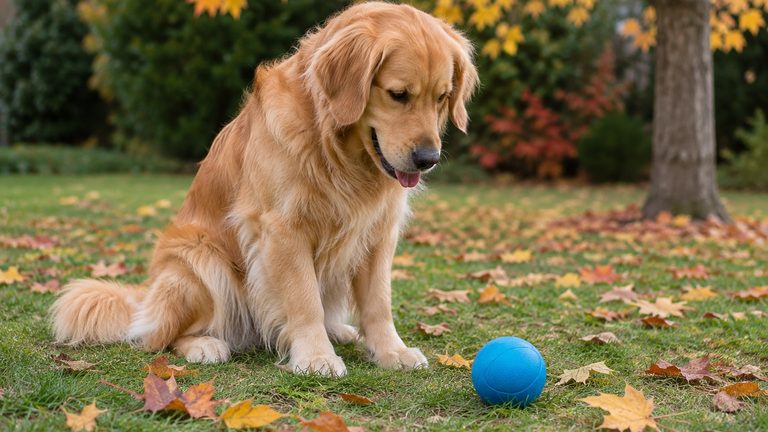
For decades, "dogs see in black and white" was repeated as a fact. It was never accurate. Behavioral tests in the 1980s and later studies have kept confirming the same picture: a dog's world has color, just a narrower palette than ours.
Two cone types instead of three
Color vision depends on cone cells in the retina. People have three kinds, which is why we can separate red, green and blue. Jay Neitz and colleagues ran behavioral discrimination experiments with three dogs in 1989 and concluded that dogs have two classes of cone pigment, with sensitivity peaks near 429 nanometers (blue) and 555 nanometers (the red-green range).1 That makes dogs dichromatic.
The American Kennel Club describes the practical result: dogs can make out yellow and blue and combinations of those colors, and they are missing the cones that separate red from green.3 VCA Animal Hospitals says a dog's normal vision is most like that of a person with red-green color blindness.4
A rough guide to a dog's palette
| What a person sees | What it likely looks like to a dog |
|---|---|
| Blue | Blue4 |
| Yellow | Yellow3 |
| Purple | Looks like blue4 |
| Red | Dark brownish gray or black4 |
| Red, pink, orange | Hard to pick out, for example against grass3 |
This is an approximation. Nobody can see through a dog's eyes, and the table summarizes what the veterinary and kennel-club sources report from the research.
How researchers know
Testing a dog's color vision is tricky, because a dog can pick the right card by brightness instead of hue. Behavioral tests like the 1989 ones are designed to rule out brightness cues.1 A 2017 study in Royal Society Open Science took another route. Siniscalchi and colleagues showed 16 dogs an animated running cat drawn in colors taken from a color-blindness test plate. The dogs responded strongly to the version that people with red-green color blindness can also see, and only weakly to the one they cannot.2
The same paper adds a caveat. Dogs are about two times worse than humans at telling brightness levels apart, and a version of the stimuli in grayscale did not trigger a clear response, which argues against brightness as the explanation.2 The sample was small, and the grayscale check used only 9 dogs, so the result is best read as one piece of evidence.2
What dogs do better than people
Weaker color vision does not mean weaker eyes overall. According to VCA, dogs see better than people in dim light, thanks to more rod cells, pupils that open wide and a reflective layer called the tapetum.4 Rods also catch movement, so dogs can pick up small motions at a distance.4 The same source notes that dogs are more nearsighted than people, so details can look blurrier to them.4
What it means for toys and play
If your dog loses a red ball in the grass, the color is the likely culprit. The AKC notes that a red, pink or orange toy may be hard for a dog to spot against grass, so it suggests blue and yellow toys, and it says a dog's apparent liking for yellow tennis balls may come down to how visible they are.3 A blue ball on autumn grass is easy to spot. When a dog searches, smell does a lot of the work, and our guide to a dog's sense of smell shows how much.
For indoor play, our roundup of dog puzzle toys is a good place to start, and how dogs understand words covers what your dog is listening for when you call it to play.