
What the symbols on clothing care labels mean
A plain-English guide to the five laundry care symbols (washtub, triangle, square, iron, circle), the dots, bars and crosses that modify them, and what US law requires on a label.
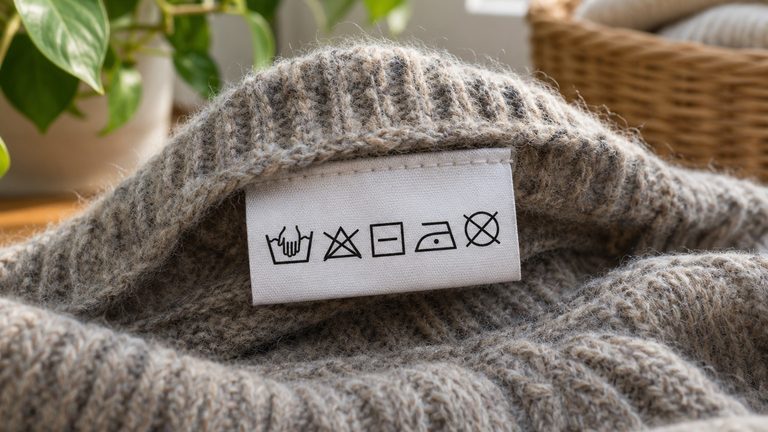
The little pictures sewn into a collar or side seam are a shorthand for care instructions, and the FTC's Care Labeling Rule has required care labels on clothing since 1971.3 Once you know how the five shapes are modified, you can read almost any label in a few seconds, in the order the label lists them: wash, bleach, dry, iron.
What the law requires on a label
In the United States, clothing care labels come from the Federal Trade Commission's Care Labeling Rule. The FTC says a wash label must state whether to wash by hand or machine, and that a label must carry a warning such as "Do not iron" when a step would harm the product.1 Tennessee Extension summarizes it as either washing or dry cleaning instructions, plus a warning about any procedure that could harm the item.3 Labels must be attached permanently and securely and must stay legible for the useful life of the garment.1
A label only has to give one safe method of care. The University of Tennessee Agricultural Extension Service points out that a garment marked "washable" may not dry clean well, because the label does not have to warn about methods it does not list.3
Symbols are optional when written instructions appear on the label.1 The FTC says only ASTM symbols are approved for use in the United States, and the rule designates ASTM Standard D5489-96c for that purpose.12 ASTM's own page says that if only symbols appear on a US label, the FTC requires the D5489-96c symbols, and that symbols from the newer D5489-18 may be used if they accompany full care instructions written in English.4 ASTM lists D5489-25 as the current version of the guide.4
The system used in Europe and much of the world, the ISO symbols, is similar but not identical, and the FTC says only the ASTM symbols are approved for use in the United States.1 Tennessee Extension adds that clothing made outside North America may use different symbols.3 So an imported garment can carry a symbol that looks familiar but means something slightly different.
The symbol reference table
The chart below follows the University of Tennessee Extension guide, which reproduces the symbols from ASTM D5489-96c.3
| Symbol | Meaning |
|---|---|
| Washtub | Machine wash. One bar underneath means permanent press cycle, two bars mean delicate or gentle |
| Washtub with a hand | Hand wash |
| Washtub with dots | Maximum water temperature, from one dot (30°C, 65 to 85°F) up to the highest listed, 95°C (200°F) |
| Crossed-out washtub | Do not wash |
| Crossed-out wringing symbol | Do not wring |
| Empty triangle | Any bleach when needed |
| Triangle with diagonal lines | Only non-chlorine bleach when needed |
| Crossed-out triangle (shown filled in) | Do not bleach |
| Square with a circle | Tumble dry. Bars mean the same cycles as for washing |
| Circle with dots, empty or solid | Dryer heat: any heat, high, medium, low, or no heat (solid circle) |
| Square with a curved line at the top | Line dry or hang to dry |
| Square with three vertical lines | Drip dry |
| Square with one horizontal line | Dry flat |
| Square with a diagonal line in the corner | Dry in the shade (added to line, drip or flat) |
| Crossed-out square | Do not dry. Crossed-out square with a circle: do not tumble dry |
| Iron with dots | Maximum temperature: 110°C (230°F) low, 150°C (300°F) medium, 200°C (390°F) high |
| Iron with crossed-out steam lines | No steam |
| Crossed-out iron | Do not iron |
| Circle | Dry clean. Letters tell the cleaner which solvent to use |
| Crossed-out circle | Do not dry clean |
The same Tennessee chart lists the letters inside the dry cleaning circle: A means any solvent, P means any solvent except trichloroethylene, and F means petroleum solvent only. Extra marks on the circle add instructions: short cycle, reduced moisture, low heat, or no steam finishing.3
How to read dots, bars and crosses
Three simple rules cover most of the chart:
- Dots are heat. More dots means a higher maximum temperature, whether the symbol is a tub, a dryer circle or an iron.3
- Bars are gentleness. More bars underneath a shape mean a milder cycle with less agitation.3
- A cross is a ban. The chart groups the crossed-out shapes as warning symbols: do not wash, bleach, dry, iron or dry clean.3
Tennessee Extension also notes that, as a minimum, laundering instructions include four symbols in a fixed order: washing, bleaching, drying and ironing. Dry cleaning instructions use a single symbol.3
Water temperature words in plain numbers
Some labels use words instead of dots. The FTC's rule defines them in its glossary: cold means an initial water temperature up to 86°F (30°C), warm is 87 to 111°F (about 31 to 44°C), and hot is 112 to 145°F (about 45 to 63°C).2 When a label gives no water temperature at all, the rule says hot water up to 145°F (63°C) can be used regularly.2
Putting it together: a worked example
Take a label with a washtub with a hand, a crossed-out triangle, a square with one horizontal line, an iron with one dot and a circle with an X. Read in order, it says: hand wash, do not bleach, dry flat, iron on low heat, do not dry clean.3 A label like that fits a delicate knit, and the guide to washing a wool sweater by hand walks through what the hand wash step involves. The guide to removing candle wax from fabric repeats the same advice from University of Georgia Extension: read the care label before any stain treatment.
Sources
- Federal Trade Commission, Clothes Captioning: Complying with the Care Labeling Rule
- Federal Trade Commission, Care Labeling of Textile Wearing Apparel and Certain Piece Goods (16 CFR Part 423)
- University of Tennessee Agricultural Extension Service, Care Label Symbols (SP519)
- ASTM International, D5489 Standard Guide for Care Symbols for Care Instructions on Textile Products