
How to choose a scratching post your cat will use
Height, stability, material and placement decide whether a cat uses a scratching post or ignores it. A checklist built on guidance from cat-welfare and behavior experts.
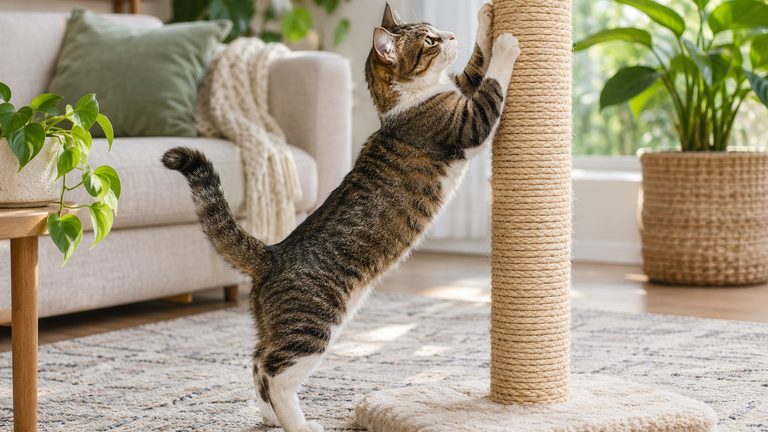
Scratching is not bad manners. International Cat Care calls it a perfectly normal behavior that exercises the muscles of the forelimbs and spine.4 The ASPCA lists several other jobs: stretching, play, marking territory, signaling to other cats, and removing frayed, worn outer claws.3 Since the urge never goes away, the goal is to give it a good outlet.
The five-point checklist
Use this list when you shop, or when you evaluate a post you already own.
- Height. Cornell says the post should be at least as tall as your cat standing on its hind legs with front legs outstretched.2 International Cat Care gives the same standard and adds that a post bought for a kitten may need replacing as the cat grows.1
- Stability. Cornell wants a post sturdy enough that it does not topple during use.2 The ASPCA says cats want a post that will not shift or collapse.3 International Cat Care points to a heavy base on upright posts.1
- Texture. The ASPCA suggests offering a mix of cardboard, carpet, wood, sisal and upholstery.3 Cornell advises matching what your cat already scratches: a cat that goes for carpet may like a carpet-covered post, while one that works a couch may prefer sisal or rope.2
- Orientation. Cats differ. Some like vertical surfaces, some horizontal or angled ones.3 International Cat Care adds that kittens or senior cats may prefer softer surfaces such as large angled or horizontal cardboard scratchers.1
- Location. See the next section, because placement is where most good posts fail.
Where to put it
Put the post where the cat spends time. International Cat Care points out that cats often scratch right after sleeping, so a spot near a favorite bed helps.1 Cornell recommends starting next to an area the cat already likes to scratch, then moving the post gradually. If the cat scratches in several places, place a post near each one.2
In a multi-cat home, International Cat Care suggests one post per cat plus an extra for choice, in different locations.1 A post is easier for a cat to use when it sits where the cat already is.
How to get a cat interested
If your cat ignores a new post, try these:
- Play a wand-toy game around the base, or put treats at the base or on top.1
- Reward use with treats, strokes and praise.2
- Try a catnip-scented post. International Cat Care notes that catnip may not suit every cat.1
- Never force your cat's paws onto the post. International Cat Care warns that this can frighten the cat and harm your bond.1
Mistakes that make a post fail
| Mistake | Why it fails |
|---|---|
| A short post | The cat cannot stretch fully2 |
| A light base | The post moves, and cats dislike that13 |
| Throwing out a worn post | Cornell says wear shows the post is being used2 |
| Only one texture or angle | Cats differ in the surfaces and angles they prefer3 |
| Punishing the cat for scratching | International Cat Care says a cat should never be punished for scratching1, and the ASPCA allows startling only as a last resort because the cat may learn to fear you3 |
A shredded post is a success. The ASPCA notes that cats prefer posts that are already shredded and familiar, so keep a ragged one in place while you add a new one beside it.3
Make the furniture less appealing, too
A new post works best when the old target is less rewarding. The ASPCA suggests covering the scratched surface with plastic, double-sided tape or sandpaper while the cat learns the new routine.3 Once the habit moves to the post, you can remove the covering.
For more on the instinct behind it, our piece on why cats knead looks at another paw habit. Scratching is also one outlet for an active indoor cat, so see keeping an indoor cat busy in winter. Bringing a new cat home? How to introduce a new cat to your home covers the first days.