
Crate training basics for dogs
How to introduce a crate step by step, how big it should be, how long a dog can stay in it, and the mistakes that turn a crate into a place a dog avoids.
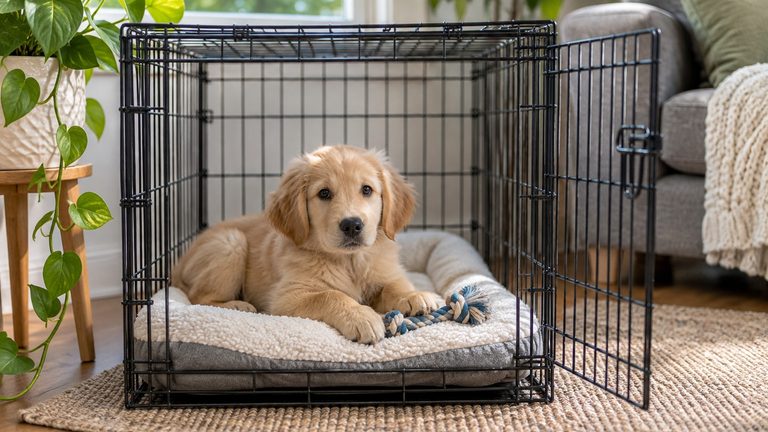
A crate is a tool, and like any tool it can be used well or badly. Used well, it gives a dog a quiet den of its own. The American Kennel Club notes that dogs instinctively seek small spaces for shelter, and that a crate can help with housebreaking because dogs generally avoid soiling the area where they sleep.3
Choose the right crate
Size matters more than style. The AKC says the crate should be big enough for the dog to stand up, lie down and turn around, and for a growing puppy it suggests buying a larger crate with a divider that sections off part of it.2 Humane World for Animals gives similar advice: choose a size that fits the puppy's adult size.4 The AKC recommends a well-ventilated crate lined with blankets to make it cozy.2 Humane World suggests a spot where the family spends time, such as the family room, but calm enough that the dog can relax without constant stimulation or noise.4
The step-by-step method
The AKC breaks crate training into six stages: awareness, exploration, getting used to it, familiarity, training and positive associations.1 In everyday terms:
- Let the dog get used to the crate. Leave the door tied open so it cannot swing shut. Toss treats near and then inside.1
- Feed meals in it. Humane World suggests putting the bowl near the entrance first, then moving it farther back over time.4
- Close the door for a few seconds. Start with a few seconds, then build slowly. When you add distance from the crate, shorten the time, and change only one thing at a time.1
- Add a cue. Once the dog walks in reliably, say "crate" or "kennel up" just before it goes in, then reward.1 Never force a dog inside. Use a lure instead.1
- Mix easy and hard sessions. Alternate short, near sessions with longer, farther ones so the dog cannot predict your absences.1
- Keep it a happy place. Reward entry now and then, and keep crate time rewarding.1
Training can take days or weeks according to Humane World, and the AKC says anywhere from a day to several months depending on the dog's personality and past experience with confinement.14 Humane World says puppies can start as early as 8 weeks old.4
How long is too long
Time limits are where the sources are most specific. The AKC says a dog should never be crated longer than it can hold its bladder, and that crating should not be all day, every day.1 Humane World says puppies under 6 months should not stay in a crate more than three or four hours at a time, and adult dogs generally should not be crated more than four or five hours during the day.4 The same page mentions a rule of "age in months plus one hour," which for a 5-month-old would allow six hours, more than the three or four hours stated earlier on the page, so the stricter limit is the one to follow.4
Take a puppy for a walk every time you let it out so it can relieve itself outdoors, and remember it needs play and meals as well as crate time.2
Mistakes to avoid
| Mistake | Why it backfires |
|---|---|
| Using the crate as punishment | It should be a safe space2 |
| Letting the door bang or bump | It can instantly reverse positive associations1 |
| Releasing the dog while it whines | It teaches the dog that crying works. Wait for a few seconds of quiet1 |
| Leaving a collar on inside the crate | It can catch on the bars1 |
| Leaving the dog crated all day | Humane World warns it can lead to depression or anxiety4 |
When the crate is not working
Some dogs panic. The AKC says nonstop crying or panic may point to separation anxiety, and in that case you should stop crate training and talk to a professional trainer or behavior consultant.1 Humane World agrees that a crate will not fix separation anxiety.4 For puppies overnight, whining may mean a trip outside is needed.1
Where a crate helps beyond housetraining
The AKC lists uses well past the puppy months: easing car travel, helping dogs settle during storms or when visitors come, and giving a rescued dog its own space to adjust.3 The visitor case is covered in our piece on holiday guests and pets.
Crate time pairs well with mental work. A stuffed toy or one of the dog puzzle toys keeps the crate rewarding. If you are building other manners at the same time, how to stop leash pulling and teaching an older dog new tricks use the same patient, reward-based approach.