What cat whiskers are for
Cat whiskers are touch sensors, not decoration. What they detect, how they show mood, why they should not be trimmed, and what a study found about the whisker bowl idea.
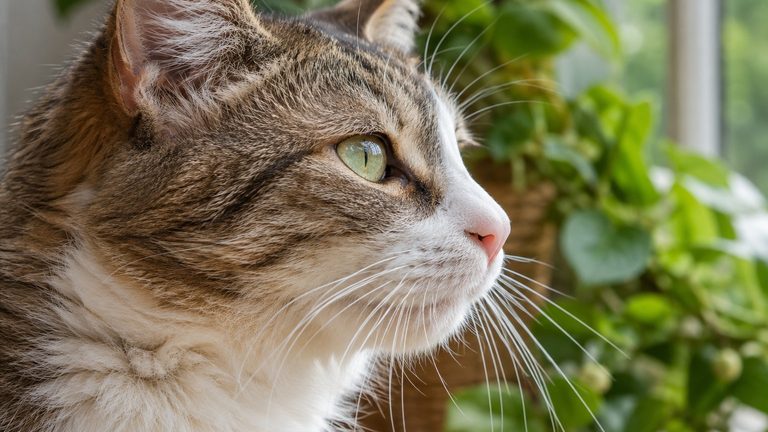
Look at a cat from the side and its whiskers frame the face like a set of antennae. They are among the most useful tools a cat has, and they do more than touch.
What makes a whisker different
A whisker is a hair, but not an ordinary one. VCA Animal Hospitals explains that whiskers are coarser and thicker than other hairs, with roots about three times deeper, and that the follicles contain many blood vessels and nerves, which makes whiskers far more sensitive than regular hair.1 International Cat Care puts it in one line: the base of each whisker is packed with nerve endings, giving cats a highly sensitive navigational system.2
Cats carry whiskers in several places: above the eyes, on the chin, on the forelegs, near the ears and above the upper lip. VCA says most cats have 12 whiskers in four rows on each cheek, though the exact pattern varies by breed.1
What whiskers do
VCA lists several jobs:1
- Radar-like sensing. Whiskers detect changes in air currents and faint vibrations, helping a cat judge nearby objects, hunt at night and avoid bumping into walls.
- Body awareness. Proprioceptors at the base of the whiskers send position information to the brain.
- Protection. Touching a whisker prompts a blink or head shake that helps clear dust from the eyes, and whiskers encourage a cat to back away from grass or thorns.
- Judging gaps. Whiskers help a cat decide whether a space is wide enough to fit through.
- A large share of the brain. VCA reports that almost 40% of the brain's sensory area corresponds to body parts with whiskers.
International Cat Care agrees that whiskers help cats judge spaces and detect air currents, which helps them find objects even after losing sight of them.2
Whiskers as a mood signal
Whisker position changes with emotion. According to International Cat Care, whiskers fan forward in front of the face when a cat is tense or highly alert, point straight out and look less spread when relaxed, and flatten against the face and bunch together when the cat is frightened or nervous.3 VCA adds that whiskers frame the eyes and rise when a cat is happy or curious.1
To read a whole cat, pair the whiskers with other cues. Our guides to what cat meows mean and the slow blink cover two more parts of the vocabulary.
Should you trim them?
No. VCA says to avoid cutting whiskers during grooming, because it may decrease the cat's awareness and cause confusion, and never to pluck or pull them. Pet gently, stroking along the direction of growth.1
What about "whisker fatigue"?
Many owners have heard that a deep food bowl makes whiskers "tired" and that a wide, shallow dish fixes it. VCA does suggest flatter food and water dishes so whiskers do not repeatedly brush the sides.1 The science is thinner. A 2021 paper (published online in 2020) in the Journal of Feline Medicine and Surgery notes that the term appears mostly in commentary and personal-opinion writing, with little evidence-based research behind it.4
The researchers tested 40 indoor cats (38 finished) with their usual bowl and a commercial "whisker-friendly" bowl. Eating behavior did not differ significantly: about 198 seconds at the new bowl against 209 seconds at the usual one, and 0.22 cups eaten against 0.21.4 Owners reported that 24 of the 38 cats preferred the new bowl, 9 preferred the usual one and 5 had no preference. The authors concluded that dish-related whisker stress did not affect the study cats' eating habits, and they noted that novelty may explain some of the preference.4
In plain terms: a wider dish does no harm and some cats seem to like it, but this study did not show that a deep bowl causes a problem.
Whisker questions, answered
| Question | Answer |
|---|---|
| Are whiskers just hair? | No. Deeply rooted, nerve-rich hairs12 |
| Do they show mood? | Yes, through position3 |
| Should I trim them? | No1 |
| Is "whisker fatigue" proven? | Not in the one controlled study cited here4 |
Whiskers are part of what makes cats so agile, a theme in how cats land on their feet.