Northern cardinals: why they stay all winter
Northern cardinals do not migrate and do not turn dull in winter. What the Cornell Lab says about their flocks, their diet and the feeders that draw them in.
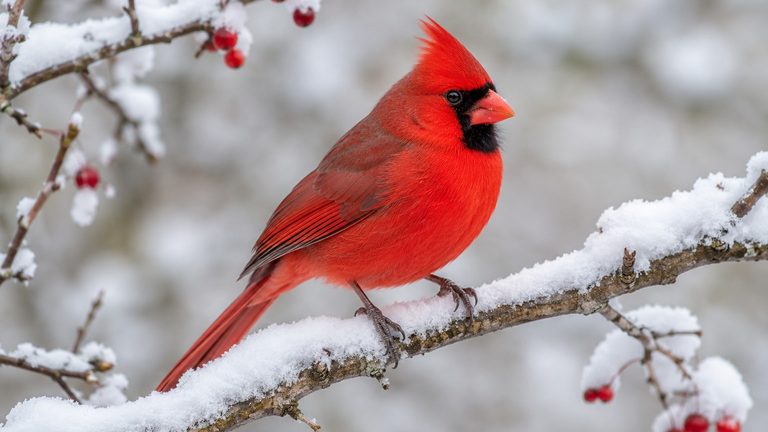
When the summer birds leave, cardinals are often the ones left in the yard. A red male on a snowy branch is one of the most recognizable sights of the cold months in the eastern United States. The reason it is there is simple: this is a bird that stays put.
Residents, not migrants
The Cornell Lab of Ornithology's All About Birds says cardinals do not migrate and do not molt into a dull plumage, so the male stays vivid in winter.1 Its identification page calls the species a year-round resident across its range, adding color to winter landscapes in the East.3
The range itself has grown. According to All About Birds, the growth of towns and suburbs across eastern North America has helped cardinals expand northward.2 The Cornell Lab lists them as abundant in eastern and central North America, with a Partners in Flight global breeding population estimate of 130 million and a "Low Concern" rating.2
How to recognize them
Cornell's identification page describes a bird slightly smaller than an American Robin, about 8.3 to 9.1 inches (21 to 23 cm) long, weighing roughly 1.5 to 1.7 ounces (42 to 48 g), with a long tail, a short, very thick bill and a prominent crest.3
- Males are bright red overall with a reddish bill and a black face around the bill.3
- Females are pale brown with warm reddish tones in the wings, tail and crest. They share the male's black face and have a red-orange bill.3
- Juveniles resemble females but have a gray to black bill.3
The crest can be raised and pointed when the bird is agitated, or lowered and barely visible at rest.2
Winter flocks and pairs
Cardinals are often seen in pairs, but winter changes the picture. All About Birds says that in fall and winter they can form flocks of a dozen to several dozen birds, and that pairs may stay together through the winter, although up to 20 percent of pairs split up by the next season.2 They sometimes forage with dark-eyed juncos, white-throated sparrows, other sparrows, tufted titmice, goldfinches and Pyrrhuloxias.2 If you want to learn the juncos that often share the ground below a feeder, see our guide to dark-eyed juncos.
What they eat
Cardinals mainly eat seeds and fruit, plus insects, according to the Cornell Lab. Natural foods include dogwood, wild grape, grasses, sedges and sumac.2 Their stout bill is built for seeds: the identification page notes that males crack sunflower seeds in the bill, then use the tongue to separate the shell from the seed.3
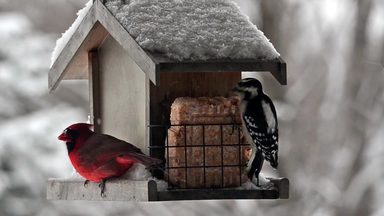
At feeders, All About Birds says cardinals eat many kinds of birdseed, particularly black oil sunflower seed.2 Project FeederWatch lists safflower as a seed that attracts cardinals and other big-billed birds, though it notes that most birds prefer sunflower.4 For a full comparison of seeds, see our guide to the best bird seed for winter feeders.
Where to look
Away from feeders, the Cornell Lab says cardinals favor dense tangles and are common but easy to miss.1 They are found in backyards, parks, woodlots and shrubby forest edges, and nest in dense tangles of shrubs and vines.3 Cornell suggests that leaving undergrowth or brushy edges in a yard may lead cardinals to nest there.1 That is a good reason not to clear every shrub in fall; our article on what to do with fallen leaves covers the leaf pile itself.
Listen as well as look. Their loud, metallic chip note helps locate hidden birds.3 Both sexes sing, and a singing female is unusual among North American songbirds.13
A short note on window fights
Cardinals sometimes attack their reflections in windows, car mirrors and shiny bumpers. Cornell says this usually happens in spring and early summer, when they defend territory, so it is less likely in winter.1 For more winter visitors, our overview of birds at backyard feeders in winter covers the other regulars.