How to keep a poinsettia looking good all season
Poinsettias can stay colorful for weeks or months with the right light, temperature and watering. Extension advice, plus the darkness schedule for rebloom next year.
Poinsettias show up everywhere in November and December, and many are discarded soon after the holidays. That is not inevitable. The plants are tropical, and the extension advice below points to the same trouble spots: cold, drafts and wet soil.
What you are actually looking at
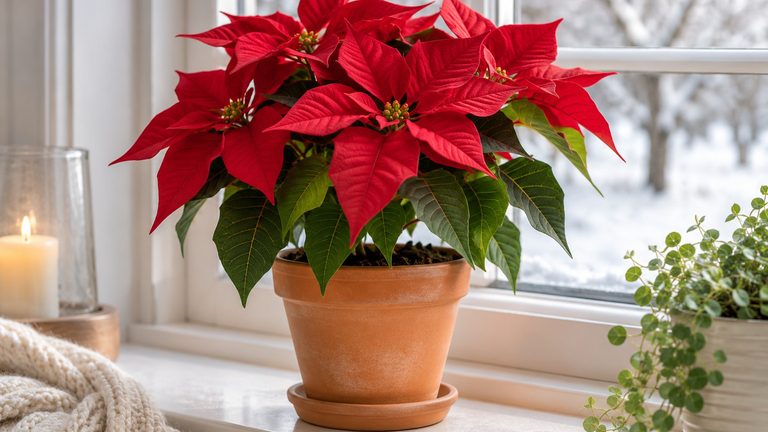
The red, pink or white "petals" are not flowers. Washington State University Extension explains that they are bracts, modified leaves, and that they are designed to attract insects to the tiny yellow flowers in the center.3 Because bracts are persistent leaves rather than short-lived petals, a healthy plant can stay colorful for a long time. The University of Illinois Extension says poinsettias can last for several weeks to several months with proper care.2
Light and placement
Iowa State University Extension advises a sunny window or other well-lit spot, but not touching a cold window pane.1 Illinois Extension recommends bright, indirect light during the day.2 WSU is more generous, calling the poinsettia a tropical plant that needs as much direct sunlight as you can provide.3 The sources differ slightly, so a reasonable middle is a very bright spot near a window where leaves are not pressed against cold glass.
Temperature and drafts
Iowa State gives a preferred range of 60 to 70°F and says to keep the plant away from cold drafts and heat sources.1 WSU gives an ideal range of 55 to 70°F, warns that poinsettias are very susceptible to changes in temperature from heating ducts, drafts from outside and even open windows, and says any frost or temperature below 45°F will kill them.3 Illinois Extension adds that cool nights help, and that you do not need to set the thermostat to 60°F.2
The trip home is the riskiest moment. Iowa State notes that even a few minutes of cold can make the bracts and leaves blacken and drop, so wrap the plant for the walk from store to car.1
Watering without overdoing it
Overwatering is the common mistake. Illinois Extension says overwatering kills more houseplants than underwatering.2 The extension advice fits together as a short routine:
- Check the soil by touch. Iowa State suggests daily; when the surface feels dry, water until it runs out the bottom of the pot.1
- Remove decorative foil wrap, or punch drainage holes in it, and discard excess water after a few minutes.2
- If the plant sits in a decorative cover, lift the pot out, water it in the sink and return it once drained.1
- If the soil gets very dry, Illinois Extension suggests soaking the pot in the sink until the soil swells and darkens, then letting it drain.2
- Water before the leaves wilt, and do not let the soil dry out completely.2
WSU adds that room temperature water suits the plant, that excess should be removed from the saucer right away, and that grouping plants nearby or running a humidifier helps in dry rooms.3
Troubleshooting what you see
| What you see | Likely cause | Fix from the sources |
|---|---|---|
| Leaves and bracts blacken and drop | Cold exposure | Keep above 45°F and away from cold glass13 |
| Pot sits in standing water | Too much water | Drain, discard standing water, water only when the surface is dry23 |
| Soil looks light and pulls away from the pot | Too dry | Soak the pot in the sink until the soil darkens and swells, then drain2 |
| Plant looks stressed near a vent or door | Temperature swings | Move out of drafts and away from heat13 |
Can you make it bloom again?
Yes, with effort. WSU says that once the bracts have fallen, you should reduce watering so the plant dries out a little, but not completely.3 Beginning in late September or early October, the plant must receive no artificial light after nightfall: even brief light from a single bulb on one night may delay or interfere with flowering.3 WSU recommends a room without lights, a dark closet or a fully light-proof cover from about 5 p.m. to 7 a.m. every day for four weeks, giving about 14 hours of total darkness a day, and keeping the plant on the dry side during that time.3
WSU itself notes that buying new plants each year is certainly easier.3 If you want more plants from one, WSU describes rooting 4 to 6 inch cuttings taken from new growth 8 to 12 inches high.3
Other plants for the winter windowsill
If your poinsettia season ends and you want another plant for the winter sill, see the Christmas cactus guide and our amaryllis article. For a watering routine across the sill, read watering houseplants in winter.