Keeping an indoor cat busy in winter
Play sessions, puzzle feeders, window perches and rotating toys give an indoor cat things to do when the weather keeps everyone inside. Ideas from cat-welfare organizations.
When the weather keeps everyone inside, an indoor cat's world shrinks to the same rooms every day. The good news is that enrichment does not need much money or space. It needs a bit of planning around what cats are built to do.
Start with what cats are built for
International Cat Care points out that cats in the wild spend up to half of their day looking for, catching and eating prey.1 A bowl served twice a day leaves long gaps, and without hunting-style outlets a cat may fill the time with sleeping and eating.1 A framework from a 2012 veterinary journal article asks owners to think about five areas: space, food and water, litter boxes, social contact, and body care and activity.3 The aim, the authors write, is a diverse, behaviorally enriched environment free from physical, psychological and social stressors.3
Ideas that work
1. Short, regular play
VCA Animal Hospitals recommends at least three short play sessions in your cat's day, ideally just before its usual active or attention-seeking times.2 International Cat Care says toys that move unpredictably work best and that interactive wand toys are a great way to play.1 Pick toys that resemble prey in size, texture and color, as VCA suggests.2
2. Make food a little harder to get
Both organizations suggest turning meals into an activity. VCA suggests delivering part of each meal through puzzle toys, hiding toys or part of the daily food around the home so the cat can seek and stalk, and splitting meals across several dishes placed in different rooms to encourage movement.2 International Cat Care adds that puzzle feeders make mealtimes more engaging.1 The 2012 article gives a concrete example: put half the daily food in a feeding toy, leave the top open at first, and make the opening smaller as the cat learns.3
3. Give height and a view
Cats are natural climbers and need to rest and watch from high places, according to International Cat Care.1 Options include cat trees, shelves with non-slip surfaces, and radiator beds. For older cats, make sure there is an easy way down.1 VCA says to place cat trees where the family spends time, not in a back room or garage, and notes that some cats prefer a window perch while others enjoy television.2
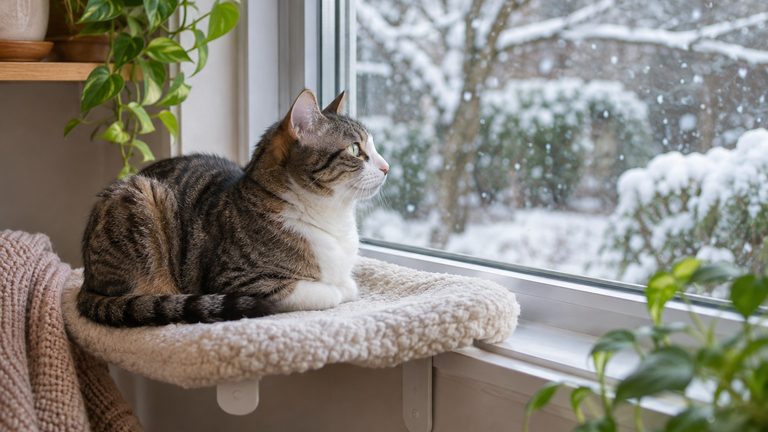
Large windows can be tricky. International Cat Care says they can confuse cats because they show the outdoors without offering cover, and suggests static film on the lower panes, a high perch nearby, or potted plants for camouflage.1 A cat watching snowfall from a padded perch is getting free entertainment. If your cat chatters at the glass, why cats chatter at birds explains the habit.
4. Keep scratching surfaces available
VCA lists scratching surfaces the cat likes, large enough to stretch out on, as part of indoor enrichment.2 Our scratching post guide covers height, stability and placement. International Cat Care adds that kittens or senior cats may prefer softer surfaces such as large angled or horizontal cardboard scratchers.4
5. Rotate the toys
Both International Cat Care and VCA advise cycling toys so they stay interesting. International Cat Care suggests rotating toys out of sight between sessions.12
A simple winter routine
| Time of day | Activity |
|---|---|
| Morning | A short wand-toy session, then part of breakfast in a puzzle feeder12 |
| Midday | A window perch with a view, or hidden food to find12 |
| Evening | Another short play session before the cat's usual active time2 |
| Weekly | Swap the toys in rotation12 |
Individual cats differ, so watch what yours responds to and do more of it. Not every cat loves puzzle feeders, and some prefer boxes, which is a whole topic in why cats love boxes.
For a look at the other half of a cat's day, see how much cats sleep.