How to remove candle wax from a tablecloth
Scrape, melt the wax into paper towels with a warm iron, then treat the leftover grease and dye. The method university extension services recommend for candle wax on a tablecloth.
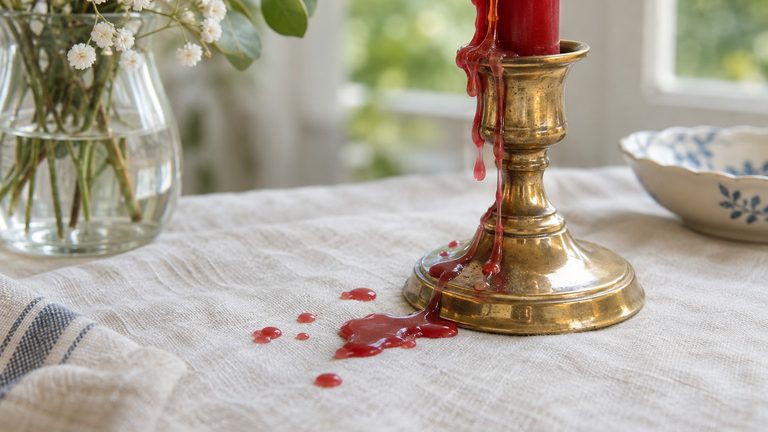
Candle wax on a tablecloth looks like permanent damage, but most of it can be lifted out with heat and paper before any washing happens. What remains afterward is a faint grease mark and, with colored candles, sometimes a tint, and each of those has its own fix.
Before you start
Read the care label first, if the cloth has one. University of Georgia Cooperative Extension says to read it before trying any stain removal method, to skip any product or procedure the label prohibits, and to pretest each cleaning agent on an inconspicuous area first to check colorfastness.1 Kansas State notes that tablecloths are not required to have a care label, but that any care steps given on one should be followed.2 If you are not sure what the symbols mean, the guide to clothing care label symbols covers them.
Step 1: scrape off the surface wax
Use a dull knife (the back of a butter knife works) to scrape off as much wax as will come away.1
Step 2: melt the rest into paper towels
This is the step that does most of the work.
- Put the stained area between several layers of white paper towels, with towels under and over it.
- Press a warm iron on top. The University of Georgia says to press from the back of the fabric.1
- The heat softens the wax so it transfers onto the towel.2
- Move to a clean part of the towel, or swap in a fresh one, and press again. Repeat until no more wax comes off.2
Kansas State University Extension stresses switching to clean paper towels each time so the wax does not spread back onto the fabric.2 Georgia likewise specifies a warm iron, not a hot one, and turning the towel as it picks up wax.1
Step 3: treat what is left behind
Even after the wax is gone, a greasy shadow often remains. Kansas State's instructions are to apply a solvent-based laundry product to the spot, then wash the item in hot water.2 The University of Georgia also suggests sponging with a commercial cleaner or waterless hand cleaner, rinsing with water, applying detergent, and then laundering in hot water, with chlorine bleach if the fabric allows it.1
"Hot" has a number here. Kansas State defines hot water as 120 to 140°F (49 to 60°C) and warm as 85 to 105°F (29 to 41°C), and tells you to follow the garment's care label for water temperature.2 If the label calls for cooler water, use the warmest setting the label allows.
Step 4: remove leftover color
Colored candles can leave a stain from the dye even when the wax is gone. The University of Georgia's remedy is to sponge the area with alcohol diluted with 2 parts water, then rinse with water.1 The page's upholstery section adds that alcohol will damage acetate, triacetate, modacrylic and acrylic fibers, so test first if you are unsure what the cloth is made of.1 If any color remains after washing, Kansas State suggests rewashing with chlorine bleach if the fabric allows it, or with oxygen bleach.2
If the wax is on something other than fabric
Candle drips land on more than tablecloths. The University of Georgia gives separate steps for other surfaces.1 On carpet, harden the wax with an ice cube in a plastic bag, scrape it with a metal spatula, then blot it with paper towels and a warm (not hot) iron. On tile, painted wood and similar hard surfaces, freeze the wax and scrape gently, then wash with washing soda or detergent (not soap) and water. On wood, the page says to remove leftover wax with mineral spirits or naphtha and buff with a chamois.
Wax problems and what to do
| Problem | What extension services recommend |
|---|---|
| Thick wax on the surface | Scrape with a dull knife |
| Wax soaked into the weave | Iron between paper towels, changing the towels often |
| Greasy mark afterward | Solvent-based laundry product, then a hot wash |
| Colored dye | Alcohol diluted with 2 parts water, or bleach if the fabric allows |
| Nothing works | Take it to a dry cleaner |
When to stop and call a dry cleaner
Kansas State's final step is practical: if the wax will not come out or the home method seems like too much work, have the item dry cleaned.2 For a delicate or heavily stained cloth, that can be easier than repeated rounds of heat and bleach.
If the care label prohibits a product or step from this list, follow the label instead.1 Once the cloth is clean, the candlestick that dripped may need attention too, and the guide to polishing silver is a good place to start if it is silver.