Baking soda or baking powder: what each one does
Baking soda needs an acid in the recipe to make batter rise, while baking powder carries its own. How each works, how to test them for freshness, and what to use if you run out.
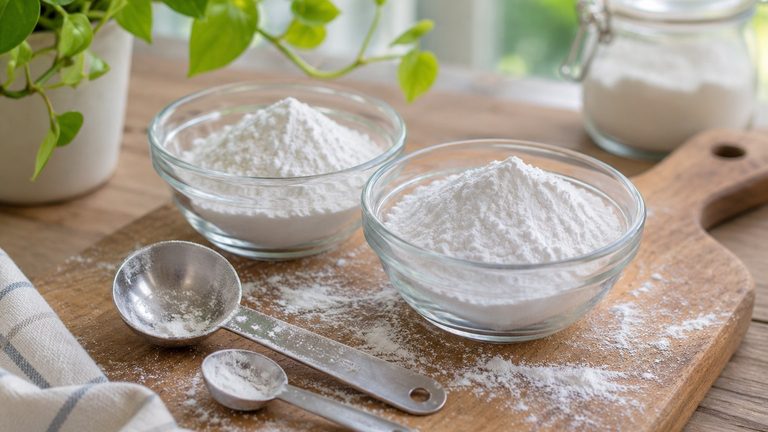
Both white powders make cakes and biscuits rise by producing carbon dioxide gas, and the two are easy to confuse in a recipe. They are not interchangeable teaspoon for teaspoon, and once you see the difference in what each one carries with it, the choices recipes make start to make sense.
What each one is
Kansas State University Extension describes baking soda (sodium bicarbonate) as an ingredient that needs an acid, such as buttermilk or vinegar, to produce the carbon dioxide that makes batters rise.1 On its own, in a batter with nothing acidic, it has nothing to react with.
Baking powder is a mix of baking soda and powdered acids, so a recipe does not need to supply an acid.1 One of those powdered acids is cream of tartar, a byproduct of winemaking.1
| Baking soda | Baking powder | |
|---|---|---|
| What it is | Sodium bicarbonate | Baking soda plus powdered acids |
| Needs an acid in the recipe | Yes | No |
| Typical partners | Buttermilk, vinegar, molasses | Milk, water, or other neutral liquids |
| How you test it | Fizzes with vinegar | Fizzes with warm water |
Why recipes use one, the other, or both
A recipe built around an acidic ingredient is a natural fit for baking soda. Buttermilk and vinegar are the examples Kansas State gives.1 Utah State University Extension adds molasses, which it notes is acidic enough to release carbon dioxide.4
A recipe with neutral ingredients, such as plain milk, needs baking powder to supply the acid. Many recipes use both, as the next example shows.
Colorado State University Extension gives a concrete example of that balance. If you swap 1 cup of buttermilk for 1 cup of milk in a recipe, its substitution chart says to add 1/2 teaspoon of baking soda and decrease the baking powder by 2 teaspoons.3 The acid in the buttermilk now does part of the work that the baking powder was doing.
Single-acting and double-acting powder
Most baking powders are double-acting, which means they rise in two phases. The first starts when wet ingredients are added. The second happens when the heat passes 170°F (77°C), in the oven.1 Single-acting powders rise only once, during baking, and a recipe will specify if you need one.1
Mix lightly and bake soon
Baking soda starts reacting as soon as it meets the acid and the liquid. Kansas State advises using the batter right away, ideally within an hour of combining the soda with an acid, and mixing lightly, because vigorous mixing breaks the bubbles.1
How to test whether yours still works
Neither powder lasts forever, and a flat cake is a poor way to find out. Kansas State gives two quick tests:1
- Baking soda: mix 1 1/2 teaspoons with 1 tablespoon of vinegar. If it fizzes, it is still usable.
- Baking powder: mix 1 teaspoon with 1 tablespoon of warm water. If it does not fizz when wet, it is no longer active and should be thrown out.
The same page lists a best-by range of 18 to 24 months for baking powder, and says it can last indefinitely if it is not contaminated, for example by a measuring spoon that has touched other ingredients.1 Store both in their original containers in a cool, dry place away from the stove, and keep baking soda out of the refrigerator, where it can absorb odors.1
If you run out of baking powder
You can make a stand-in from baking soda plus an acid, but sources give slightly different formulas, so follow the one that matches what you have in the pantry. For each 1 teaspoon of baking powder:
- University of Illinois Extension says to substitute 1/4 teaspoon baking soda and 5/8 teaspoon cream of tartar.2
- Kansas State gives 1/4 teaspoon baking soda, 1/2 teaspoon cream of tartar and 1/4 teaspoon cornstarch.1
- Colorado State lists 1/4 teaspoon baking soda plus 1/2 cup of buttermilk, sour milk or yogurt, and says to decrease the liquid in the recipe by 1/2 cup.3 Utah State lists the same amount of baking soda with 1/2 cup of fully soured milk or buttermilk.4
If you have no cream of tartar, Kansas State says 1 1/2 teaspoons of lemon juice or vinegar can stand in for it.1 Illinois Extension lists a different ratio for the same swap, 1/2 teaspoon of lemon juice or vinegar for each 1/2 teaspoon of cream of tartar, so treat the numbers as approximate and expect a slightly different crumb.2
The extension sheets above list no matching swap in the other direction, so when a recipe asks for baking soda and you have only powder, the safest move is to pick up a box. For related substitutions, see the guide to buttermilk substitutes and the guide to egg substitutes in baking.
Measure with a clean, dry spoon
Kansas State's note about contaminated measuring spoons is a reminder to use a clean, dry spoon every time you dip into a container of leavener.1 The guide to measuring flour correctly covers the same leveling technique for the bigger measure, and the guide to high-altitude baking adjustments is the place to look if you bake where the air is thin.
Sources
- Kansas State University Research and Extension (Johnson County), 3 Key Chemical Leavening Agents in Baking
- University of Illinois Extension, Recipe Substitutions
- Colorado State University Extension, Ingredient Substitutions (Fact Sheet 9.329)
- Utah State University Extension, List of Ingredient Substitutions for Cooking and Baking