What to use when a recipe calls for buttermilk
Milk plus a tablespoon of vinegar or lemon juice stands in for buttermilk in baking. The ratio, the wait, the yogurt and cream of tartar options, and how to scale down.
The carton of buttermilk is rarely there when a pancake or biscuit craving strikes. The good news is that buttermilk's job in baking is simple to copy at home, and several university extension services publish the same stand-ins.
What buttermilk does in a recipe
Buttermilk is acidic, and that matters because baking soda needs an acid to produce the carbon dioxide that makes batter rise. Kansas State University Extension names buttermilk and vinegar as typical acids that baking soda pairs with.4 So when a recipe calls for buttermilk, it is often doing chemistry as well as adding liquid. Any substitute has to bring the acid along.
That is why plain milk alone is not a good swap in a recipe that uses baking soda: it is a liquid without the acid. The cure is to add the acid yourself.
The standard substitute: milk and an acid
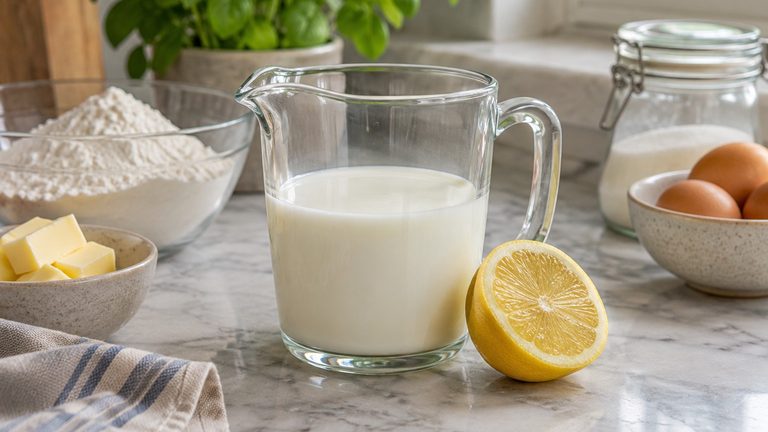
University of Illinois Extension's substitution chart gives the formula: for 1 cup of buttermilk, use 1 tablespoon of lemon juice or vinegar plus enough regular milk to make 1 cup, and let it sit for 5 minutes.1 Utah State University Extension lists the same formula: 1 tablespoon of vinegar or lemon juice, enough milk to make 1 cup, and 5 minutes of standing time.2
Colorado State University Extension words it slightly differently. It says to use 1 cup of milk minus 1 tablespoon, then add 1 tablespoon of vinegar or lemon juice, and let stand 5 minutes.3 Both versions end at exactly 1 cup, so either works. Measure the acid first, then pour in milk up to the cup line.
The extension sheets list vinegar and lemon juice as equal choices, so use whichever you have.13
Other stand-ins
| Substitute for 1 cup buttermilk | Source |
|---|---|
| 1 tablespoon vinegar or lemon juice plus milk to make 1 cup, rested 5 minutes | Illinois, Utah State, Colorado State123 |
| 1 cup plain yogurt | Utah State, Colorado State23 |
| 1 3/4 teaspoons cream of tartar plus 1 cup milk | Utah State2 |
| 1 cup sweet milk plus 1 1/4 to 1 3/4 teaspoons cream of tartar | Colorado State3 |
The cream of tartar versions are worth knowing if the pantry has it but the refrigerator has no lemon. The two sheets give slightly different amounts: Utah State says 1 3/4 teaspoons, while Colorado State gives a range of 1 1/4 to 1 3/4 teaspoons.23
A worked example
Say a pancake recipe calls for 3/4 cup of buttermilk. The sheets give 1 tablespoon of acid per cup, so 3/4 cup takes 3/4 tablespoon (our arithmetic, scaled in proportion), which is 2 1/4 teaspoons of vinegar or lemon juice. Measure that into a liquid measuring cup, add milk up to the 3/4 cup line, stir, and leave it for the 5 minutes the extension sheets call for.12 Then add it to the batter exactly as the recipe says buttermilk goes in.
If you would rather skip the acid step, the yogurt route is even simpler. Utah State and Colorado State both list 1 cup of plain yogurt for 1 cup of buttermilk, so there is nothing to stir and nothing to wait for.23
How to scale it down
Recipes often call for half a cup or less. Because 1 tablespoon equals 3 teaspoons, the acid scales in a straight line. The extension sheets give the rule for a full cup (1 tablespoon of acid per cup).12 These amounts are that rule scaled in proportion, our arithmetic rather than figures printed on the sheets:
- 1/2 cup: 1 1/2 teaspoons of vinegar or lemon juice, then milk to the 1/2 cup line
- 1/4 cup: 3/4 teaspoon of vinegar or lemon juice, then milk to the 1/4 cup line
- 2 cups: 2 tablespoons of vinegar or lemon juice, then milk to the 2 cup line
The kitchen conversion guide has the full tablespoon, teaspoon and cup equivalents if you need other amounts.
The reverse swap: using buttermilk in place of milk
Sometimes you have the opposite problem and want to use up buttermilk in a recipe written for milk. Colorado State University Extension's chart covers it: swap 1 cup of buttermilk for 1 cup of milk, add 1/2 teaspoon of baking soda, and decrease the baking powder by 2 teaspoons.3 The added acid from the buttermilk now takes over part of the leavening, which is the idea behind the guide to baking soda versus baking powder.
Related baking guides
If a recipe also needs eggs you do not have, the guide to egg substitutes in baking covers that swap, and the guide to measuring flour correctly helps with the dry side of the batter. Start any substitution with the amounts above, and write down what you used so you can repeat it.
Sources
- University of Illinois Extension, Recipe Substitutions
- Utah State University Extension, List of Ingredient Substitutions for Cooking and Baking
- Colorado State University Extension, Ingredient Substitutions (Fact Sheet 9.329)
- Kansas State University Research and Extension (Johnson County), 3 Key Chemical Leavening Agents in Baking