How to measure flour correctly for baking
Scooping packs flour and can give you about 150% of what the recipe wants. How to spoon and level a cup of flour, why a kitchen scale is more accurate, and which cup to use.
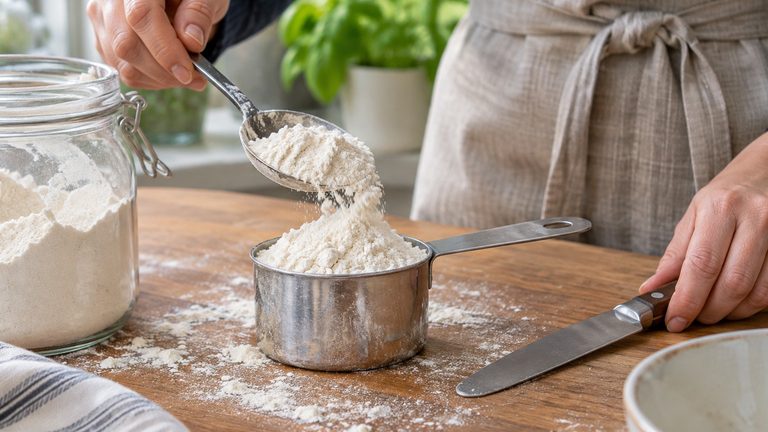
A cup of flour is not a fixed weight. It depends on how tightly the flour is packed, so the same "1 cup" can mean different amounts. The fix costs nothing: change how the flour gets into the cup.
Why the scoop goes wrong
When you plunge a measuring cup into a bag or canister, the flour compresses against the cup. University of Illinois Extension warns that dipping the cup into flour packs it down and can give you about 150% of the amount a recipe calls for.1 Texas 4-H guidance gives the same warning: do not use the measuring cup to scoop flour out of the container, because you can end up with 150% of the correct measurement.2
Texas 4-H also stresses why this matters in baking. For cookies, cakes, breads and pie crusts, measuring accurately is critical to the success of the recipe, while for casseroles, soups and stir fries amounts can vary more without hurting the result.2
The spoon-and-level method
Both Illinois Extension and Texas 4-H describe the same steps:12
- Stir the flour in its container or bag to loosen it.
- Spoon it lightly into a dry measuring cup with a large spoon, until the flour heaps over the top. Do not shake the cup and do not pack the flour down.
- Level it off with the back of a knife or a flat spatula, even with the top edge of the cup.
- Do the leveling over the flour container or a sheet of wax paper, not over your mixing bowl, so the extra goes back where it came from.1
Use the right cup
Dry and liquid ingredients are not measured in the same cup. Illinois Extension advises a clear liquid measuring cup with a pouring spout for liquids like oil, honey and cream, and dry measuring cups for dry ingredients like flour and sugar.1 The National Institute of Standards and Technology (NIST) calls using a dry cup where a fluid cup is intended a common way of introducing measurement errors into cooking, and recommends striking off excess dry ingredients with a flat edge when using a dry cup.3
When weighing is better
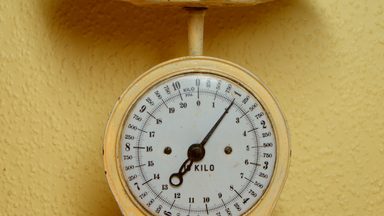
NIST describes measuring by mass as a best practice that improves recipe accuracy compared with measuring by volume in dry or fluid cups.3 A digital kitchen scale takes packing out of the equation entirely: it measures how much flour there is, not how much space it fills.
If a recipe lists grams, use them. If you are converting an American recipe that lists cups, NIST suggests measuring the ingredient with the traditional tool and then weighing the result in grams on a kitchen scale, so you have a number to repeat next time.3 NIST also reminds cooks that the density of different ingredients matters, which is why a cup of flour and a cup of sugar do not weigh the same.3 That also means a single converter cannot turn cups of flour into grams without knowing the ingredient. Weigh the first spoon-and-level cup, write the number on the recipe card, and use it next time. The kitchen conversions guide lists the standard volume equivalents.
Three ways to measure, compared
| Method | How | Accuracy |
|---|---|---|
| Dip and scoop | Plunge the cup into the flour | Packs the flour, can give about 150% of the right amount12 |
| Spoon and level | Stir, spoon lightly, strike off | Much closer, no scale needed12 |
| Weigh | Flour in a bowl on a scale | Best practice per NIST3 |
Other dry ingredients
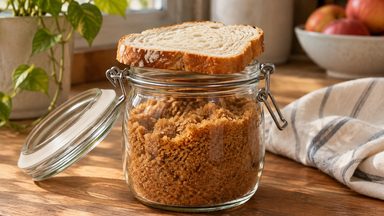
The same Texas 4-H lesson covers leaveners and sugar. For baking powder and baking soda, stir in the container, lightly scoop with the measuring spoon, and level off with a knife, since accurate amounts of these are critical to the success of any baked product.2 Brown sugar is the exception: it needs to be packed into the cup, and the sugar should keep the shape of the cup when it is dropped into the other ingredients.2 Illinois Extension adds that brown sugar should be packed (pressed firmly into the cup) only if the recipe specifies it.1
If your brown sugar has turned to a brick, the guide to softening hard brown sugar fixes it before you measure. For the chemistry of the small spoon measures, see the guide to baking soda versus baking powder, and the guide to flaky pie crust is another baking guide where measuring pays off.