How to wash a wool sweater without shrinking it
Wool shrinks from wet washing and tumble drying. Check the label, wash in lukewarm water with mild detergent, squeeze rather than wring, and dry away from heat.
A wool sweater that comes out of the laundry two sizes smaller is a familiar disappointment, and it is hard to undo. The good news is that the causes are known, and a hand wash that respects them takes about as long as a load of dishes.
Why wool shrinks
The University of Hawaii's College of Tropical Agriculture and Human Resources notes that shrinkage of wool usually occurs as a result of wet laundering and tumble drying.2 Ohio State University Extension is blunt about the dryer: wool sweaters should never be put in it, because heat can make them "felt" and shrink dramatically.3
Virginia Cooperative Extension sums up the handling that goes with this. Wool usually needs more gentle handling than other fabrics: lukewarm water, minimum agitation and mild detergents.1
Step 1: read the label
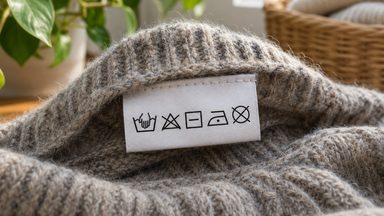
Not every wool garment is meant for the sink. Virginia Cooperative Extension says that some wool is treated to make it less susceptible to shrinkage from washing, and tells you to check hang tags and the care label for specific information.1 Ohio State likewise advises reading the care label closely. It says some sweaters made with synthetic fibers can be machine washed on cold and tumble dried on low and keep their shape, while a sweater made with natural fibers, such as certain types of wool, may be recommended for hand washing or the hand wash cycle on the washing machine.3 The guide to reading care label symbols explains the washtub with a hand, the crossed-out symbols, and what a dry clean circle means.
If the label says to dry clean only, follow it. The University of Hawaii's chart notes that wool can be wet or dry cleaned, but dry cleaning is the preferred method for minimizing shrinkage.2
Step 2: wash gently by hand
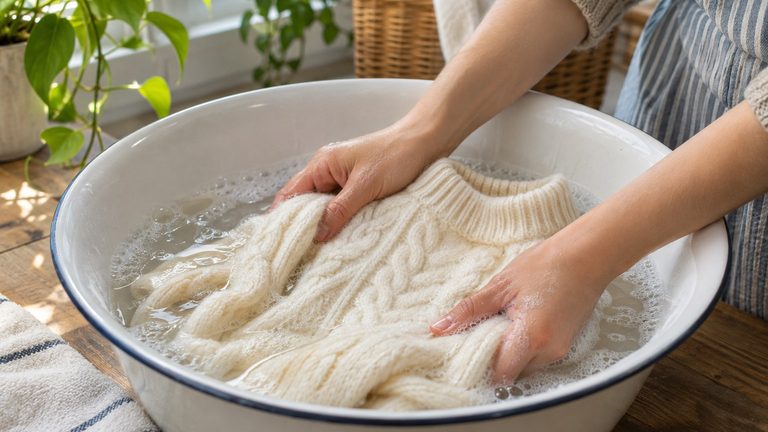
If the label allows hand washing, a sink or basin is enough.
- Fill the basin with lukewarm water, never hot.1
- Add a small amount of mild detergent. Virginia Cooperative Extension says the mild liquid detergents made for hand dishwashing are also appropriate for washing wool.1
- Move the sweater gently through the water. Skip scrubbing and rubbing, since minimum agitation is what Virginia Cooperative Extension asks for with wool.1
- Rinse in clean lukewarm water, using the same gentle handling.
- Skip bleach. Virginia Cooperative Extension advises against using chlorine bleach on wool.1
Step 3: rinse, press out the water and dry
Oklahoma State University Extension gives a short routine for woolen garments labeled hand-washable.4 Its steps, in order:
- Rinse twice in clean water that is the same temperature as the wash water.
- Squeeze suds through the sweater without twisting or wringing it.
- Gently squeeze out the excess water, then roll the sweater in a towel.
- Smooth it back to its original shape. For knits, the guide suggests tracing the outline of the dry garment on paper beforehand and pinning the wet sweater to that pattern.
- Dry it away from sunlight and direct heat.
The pattern is worth the two minutes if the sweater has a close fit, since a wet knit is easy to pull out of proportion while you smooth it.
Step 4: keep it away from the dryer
Drying is where most sweaters shrink. The University of Hawaii's chart answers "No" for the dryer under wool, and Ohio State says wool sweaters should never go in it.23 Follow whatever drying instructions the care label gives, and treat heat as the thing to avoid.3
Acrylic is a useful contrast. The University of Hawaii notes that acrylic has characteristics comparable to wool but will not shrink when wet cleaned the way wool often will, so a label that allows machine washing for an acrylic sweater does not carry over to wool.2
Wool care do's and don'ts
| Do | Avoid |
|---|---|
| Check the care label and hang tag first13 | Assuming every wool garment is washable |
| Use lukewarm water and a mild detergent1 | Hot water, chlorine bleach1 |
| Handle gently with minimum agitation1 | Vigorous scrubbing or rubbing |
| Squeeze out water and roll the sweater in a towel4 | Twisting or wringing4 |
| Smooth it back to its original shape4 | Leaving it stretched or misshapen |
| Dry away from sunlight and direct heat4 | Sun, radiators and other direct heat4 |
| Keep it out of the dryer23 | Tumble drying wool23 |
| Fold to store3 | Hanging it up, which can stretch it3 |
Storing it clean
Ohio State advises folding clean sweaters and putting them in a drawer or on a shelf rather than hanging them, because hanging can stretch a sweater or create bumps in the shoulder area.3 Before the sweater goes back in a drawer, make sure it is clean and completely dry. Ohio State warns that soiled sweaters in storage can attract cloth-damaging insects, and recommends treating stains before storing, because aging stains can darken over time.3 A cool, dark and dry place is its suggestion for winter wear.3
If a sweater has picked up something sticky, the stain methods in the guide to removing candle wax from fabric show how extension services approach grease and wax, but check the care label before applying any stain remover to wool.
Sources
- Virginia Cooperative Extension, The Laundry System (Publication 346-030)
- University of Hawaii at Manoa CTAHR, Recommendations for Cleaning Garments and Textiles (AT-1)
- Ohio State University Extension, Sweater Weather
- Oklahoma State University Extension, Everything But The BAA! Study Guide (wool garment care)